The Silent Superheroes: Why Every Tree is a Tiny Miracle
Imagine a serene morning where the only ones awake are the early birds. At the edge of a sandy playground, a little sapling sits rooted in the dirt. To most people, it’s just a common plant, a frail thing laboring to grow. But inside that minuscule stem is a power move: the potential to change the very air we breathe and blueprint an entire ecosystem.
The World’s Quietest Laboratory
Trees aren’t exactly attention seekers. They don’t wander, they don’t shout, and they grow at a pace that makes a snail look like a sprinter. But inside their quietness is a high-tech lab. Every leaf is a tiny workstation where photosynthesis happens.
By mixing sunlight, carbon dioxide, and water, trees create energy and oxygen. Essentially, they breathe in what we exhale and give back the one thing we can’t live without. It’s a silent partnership we often forget, yet a single mature tree can absorb about 20 kg of CO2 every year. Scale that up, and forests become our planet’s most effective “geoengineering” solution.
The “Wood Wide Web”
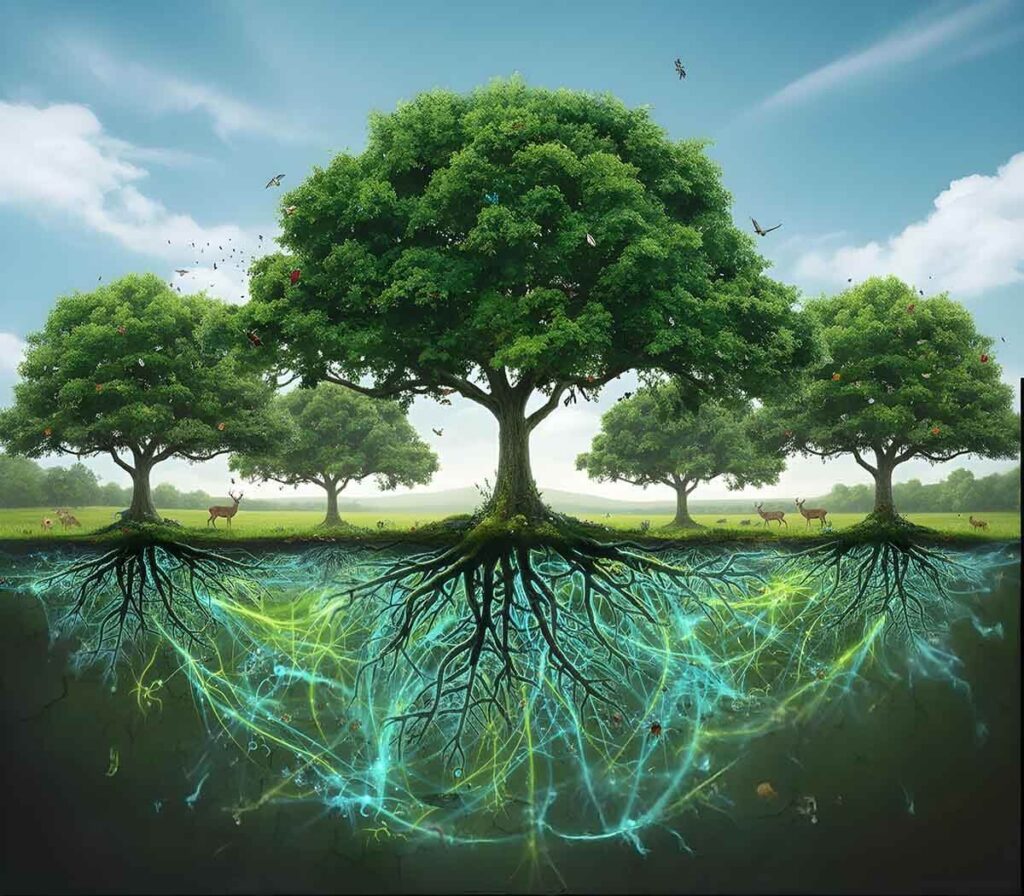
Forests aren’t just a collection of trunks; they are a social network. Beneath the soil lies an invisible web of fungal threads called mycorrhizae or, as some call it, the “Wood Wide Web”.Through this underground internet, trees actually talk. They share nutrients and even send out “pests detected!” alerts to their neighbours. This collaboration makes them incredibly resilient, helping them regulate rainfall, stabilize soil, and provide a home for nearly 80% of all land-based life. From giant elephants to tiny microbes, the forest is the ultimate landlord.
Nature’s Air Conditioning
Ever noticed how a city street feels like an oven in July? Without trees, we get the “Urban Heat Island” effect. Trees act as nature’s air conditioning, using their shade and a process called transpiration to naturally cool the air.
When we lose these “ecosystem engineers” to urbanization or agriculture, the system begins to sicken. The trapped carbon is released, biodiversity suffers, and we lose the very species that give us everything from aspirin to life-saving medicines.
The Long Game
The impact of a tree doesn’t take centuries to start. From the moment they are connected with soil, the process begins, young trees begin filtering the air and binding the earth with their roots. That little sapling on the playground might take years or even decades to provide a full canopy of shade, but its journey has already begun.
Every tree ever planted in this ecosystem is an investment in stability. When we grow forests, we aren’t just putting sticks in the ground; we are planting resilience, balance, and hope.
Next time you pass a tree, give it a warmest “HUG“ (like kaira does in Dear Zindagi) or a silent “thank you.” It’s working harder than you think.